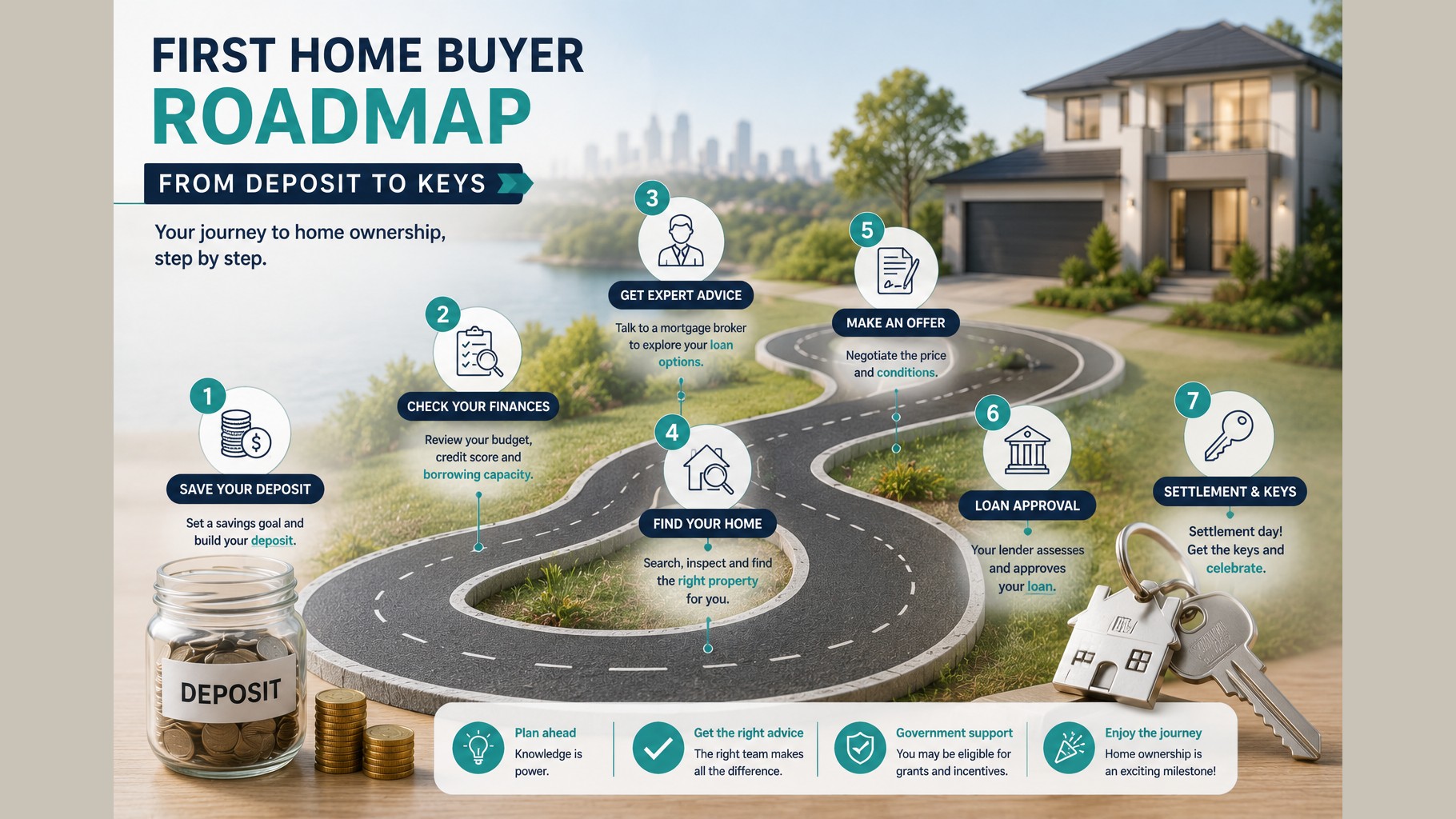
Buying your first home feels enormous because you''re looking at the whole thing at once. Break it into steps and it becomes a process you can actually manage. Here''s the full journey in order, with the trap that catches people at each stage.
Step 1: Work out what you can actually borrow
Before you look at a single listing, find your real borrowing capacity. It''s driven by your income, your existing debts, your living expenses and the interest rate lenders test you at — not what you hope to spend. A mortgage broker or a lender can give you a genuine number in an afternoon.
The trap: shopping above your budget "just to look". You''ll fall for something you can''t finance.Step 2: Save the deposit (and understand the LMI trade-off)
Traditionally you aim for 20% of the price to avoid Lenders Mortgage Insurance (LMI) — a one-off cost that protects the lender, not you, when your deposit is smaller. But waiting to save 20% in a rising market can cost more than the LMI would. Many first-home buyers deliberately buy sooner with a smaller deposit and accept the LMI, or use a government scheme to avoid it.
The trap: assuming you must have 20%. Sometimes buying earlier with less is the better financial call — run the numbers both ways.Step 3: Get pre-approval
Pre-approval is a lender''s conditional agreement to lend you up to a certain amount. It tells you your ceiling, signals to sellers that you''re serious, and lets you move quickly when you find the right place.
The trap: treating pre-approval as a guarantee. It''s conditional — the lender still has to approve the specific property and re-check your situation.Step 4: Search — and do your homework on value
Now you look. Inspect widely, learn what your money actually buys in your target suburbs, and check recent comparable sales so you know a fair price when you see one. This is where a buyer''s agent can help if you''re time-poor or buying somewhere you don''t know well.
The trap: emotional attachment. The moment you need a specific house, you lose your negotiating power.Step 5: Make an offer or bid at auction
Private sale means negotiating on price and terms; auction means bidding in public with no cooling-off period. They call for different strategies — and at auction, a pre-set walk-away limit is your best protection against getting carried away.
The trap: bidding past your limit "because we''re so close". That''s exactly when the most expensive mistakes happen.Step 6: Finance, inspections and the contract
Once your offer is accepted (or you win the auction), your lender formally approves the loan against that property, and you arrange building and pest inspections. In a private sale you usually have a cooling-off period; at auction you don''t, so do your due diligence before you bid.
The trap: skipping the building and pest inspection to save a few hundred dollars — and inheriting a problem that costs tens of thousands.Step 7: Settlement and the keys
Settlement is the day the money changes hands and the property becomes yours, usually a few weeks after exchange. Your conveyancer or solicitor handles the legal transfer; you do a final inspection to check the property is as agreed.
The trap: big financial changes between approval and settlement — a new car loan, a job change — that can put your finance at risk right at the finish line.The help available to first-home buyers
Australia has a range of first-home buyer schemes — grants, stamp-duty concessions and guarantees that can reduce or remove LMI. Eligibility, caps and availability change and vary by state, so check the current rules for your state before you count on any of them. A mortgage broker can tell you which you qualify for.
The bottom line
You don''t buy a house in one move — you take seven steps, and each has one main trap. Know your real budget, get pre-approved, do your due diligence before you commit, and never let emotion push you past your limit. Do that, and the leap from deposit to keys becomes a series of manageable steps.