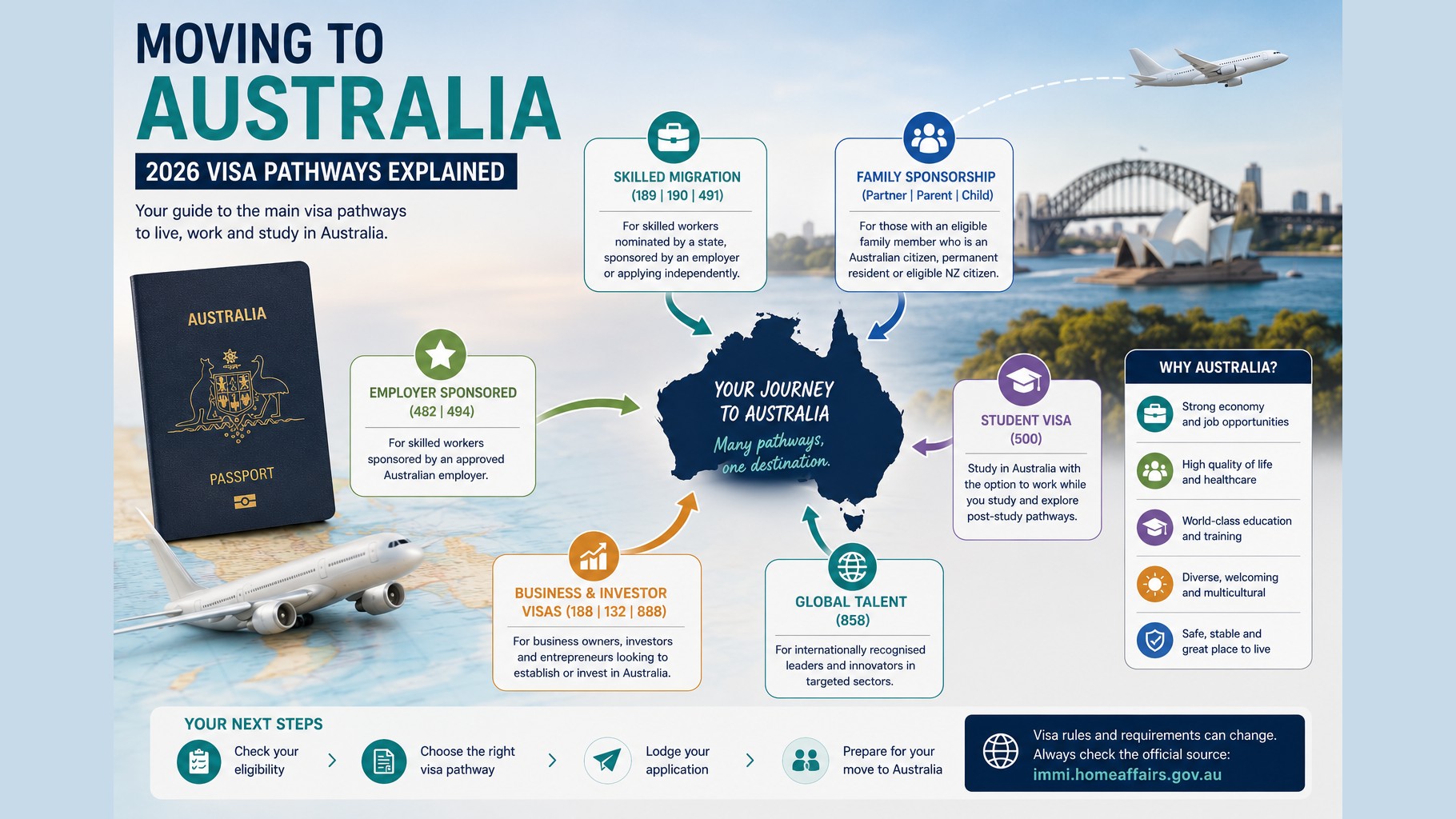
Australia''s migration system is famously complex — dozens of visa subclasses, points tests, occupation lists and eligibility rules that change with the political weather. But underneath the alphabet soup, most people arrive through one of just five pathways. Once you can see the map, your own route gets a lot clearer.
Start with the honest question: why are you moving?
Before you look at a single visa subclass, get clear on your actual goal. Are you chasing permanent residence as fast as possible? Coming for a specific job? Following study? Joining family? Your answer points you straight at the right pathway — and stops you wasting months on a visa that was never going to fit.
The most common mistake is falling in love with a visa you read about online, then trying to bend your life to qualify for it. Work the other way around: start with your situation, then find the visa.
The five main pathways
1. Skilled (points-tested) visas
For people with an occupation Australia wants, who can qualify on their own merits — no employer or family needed. You lodge an Expression of Interest, score points for age, English, qualifications and work experience, and wait to be invited. It''s the classic "independent migrant" route, and it''s competitive: high scores get invited first.
Best for: younger professionals with strong English and an in-demand occupation.2. Employer-sponsored visas
An Australian employer sponsors you for a role they can''t easily fill locally. These can be temporary or lead directly to permanent residence. The trade-off: your visa is tied to the job and the employer, at least initially.
Best for: people with a genuine job offer, or skills an employer will sponsor.3. Study-to-stay pathways
Come as an international student, then use post-study work rights and skilled pathways to stay longer. It''s slower and more expensive up front, but it lets you build Australian qualifications, work experience and networks that strengthen a later PR application.
Best for: younger people who can invest in study first and play the long game.4. Family and partner visas
If you have a partner, parent or child who is an Australian citizen or permanent resident, family visas may be your route. Partner visas are the most common — and among the most document-heavy, because you have to genuinely prove the relationship.
Best for: people with a close family or partner connection to Australia.5. Business and investment visas
For entrepreneurs and investors willing to start or buy a business, or invest a substantial sum. These have shifted a lot in recent years and tend to carry high financial thresholds.
Best for: experienced business owners and significant investors.How to work out which pathway fits
Ask yourself, in order:
- Do I have a partner or close family who are Australian? → look at family.
- Do I have (or can I get) an Australian job offer? → look at employer-sponsored.
- Is my occupation on a skilled list and do I score well? → look at skilled.
- Am I willing to study here first? → look at study-to-stay.
- Do I have business experience and capital to invest? → look at business/investment.
A word on timing and "the points race"
For skilled visas especially, meeting the minimum is not the same as getting invited. Invitation rounds favour the highest scores, and cut-offs move. A few extra points — better English, a partner''s skills, a professional year — can be the difference between an invitation this year and waiting indefinitely. If you''re close to a threshold, it''s often worth the effort to push your score up before you lodge.
Do you need a migration agent?
Not legally — you can lodge most applications yourself. But immigration advice for a fee can only be given by a registered migration agent (check their MARN on the OMARA register) or a lawyer. A good agent earns their fee on complex cases: borderline eligibility, past refusals, tricky documentation, or when getting the strategy wrong costs you years. For a straightforward, clearly-eligible application, many people do it themselves.
If you do engage one, compare a few, check the registration, and get the fee in writing before you commit.
The bottom line
Australia''s visa system is complicated in the details but simple in shape: five pathways, and your circumstances decide which one is yours. Work from your situation to the visa — not the other way around — and get the timing and points right before you lodge. That single shift in approach saves more failed applications than any insider trick.