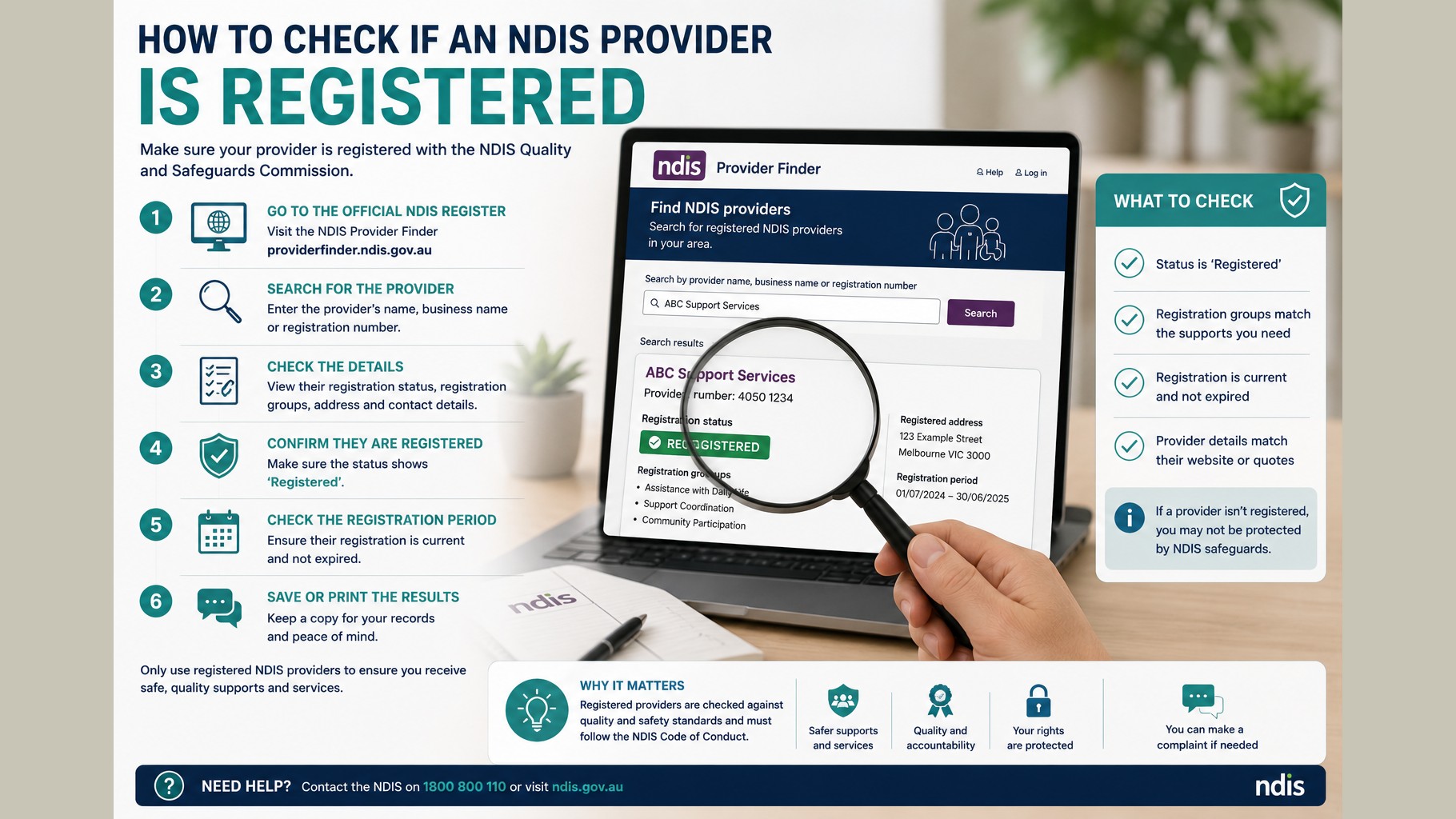
Why Registration Matters
Registered NDIS providers are regulated by the NDIS Quality and Safeguards Commission. Registration means the provider has been audited against the NDIS Practice Standards, its workers are subject to screening requirements, and — importantly — there is a formal complaints and compliance system behind it. Unregistered providers can be perfectly good, and plan-managed or self-managed participants are free to use them, but you lose that regulatory backstop.
If your plan is agency-managed, you can only use registered providers — so the check below is essential.
The Ten-Minute Check
Step 1: Search the Provider Register. Go to the NDIS Commission website (ndiscommission.gov.au) and use "Find a registered provider". Search by the provider''s exact business name or ABN. Each registered provider has a public page showing their ABN, head office, registration status and the date their registration runs to. Step 2: Confirm the status is current. Look for an approved registration that is still in force. A lapsed or revoked registration is disqualifying for agency-managed plans and a warning sign for everyone else. Step 3: Check the registration groups. Registration is not all-or-nothing — providers are registered for specific classes of supports. A provider registered for daily personal activities is not necessarily registered for behaviour support or SIL. Confirm they are registered for the specific supports you need. Step 4: Check compliance history. The Commission publishes compliance actions — banning orders, compliance notices and enforceable undertakings. Search the Commission''s compliance area for the provider''s name. A formal compliance action does not always mean a provider is unsafe today, but it is something to ask them about directly, and a banning order is a hard stop. Step 5: Verify worker screening. Ask whether the workers who will support you hold NDIS Worker Screening clearances. Registered providers must ensure risk-assessed roles are held by cleared workers — asking the question tells you how seriously they take it.Questions Worth Asking Any Provider
- Are you registered for the specific support categories in my plan?
- Who exactly will be supporting me, and what screening do they hold?
- What happens if my regular worker is unavailable?
- How do I raise a concern, and what is your complaints process?
- What are your cancellation terms? (Check them against the current NDIS Pricing Arrangements.)
Registered vs Unregistered: The Practical Difference
If you are plan-managed or self-managed, unregistered providers are an option, and some excellent small supports operate unregistered because the audit burden is heavy for sole operators. The trade-off is yours to weigh: unregistered providers are not audited against the Practice Standards and sit outside some Commission powers. For high-intimacy or high-risk supports — personal care, behaviour support, SIL — many participants reasonably prefer the registered pathway.
The Bottom Line
The register is public, free, and takes minutes to check — including the compliance history most people never look at. On CompareMyAgents, every NDIS provider listed is verified against the Commission register, including a compliance check, before appearing — but do your own check too. It is your plan, your funding and your home.
This article is general information only — it is not disability, health or NDIS planning advice. Rules and registration requirements change; verify current details with the NDIS Commission and your planner or support coordinator.