The Short Version
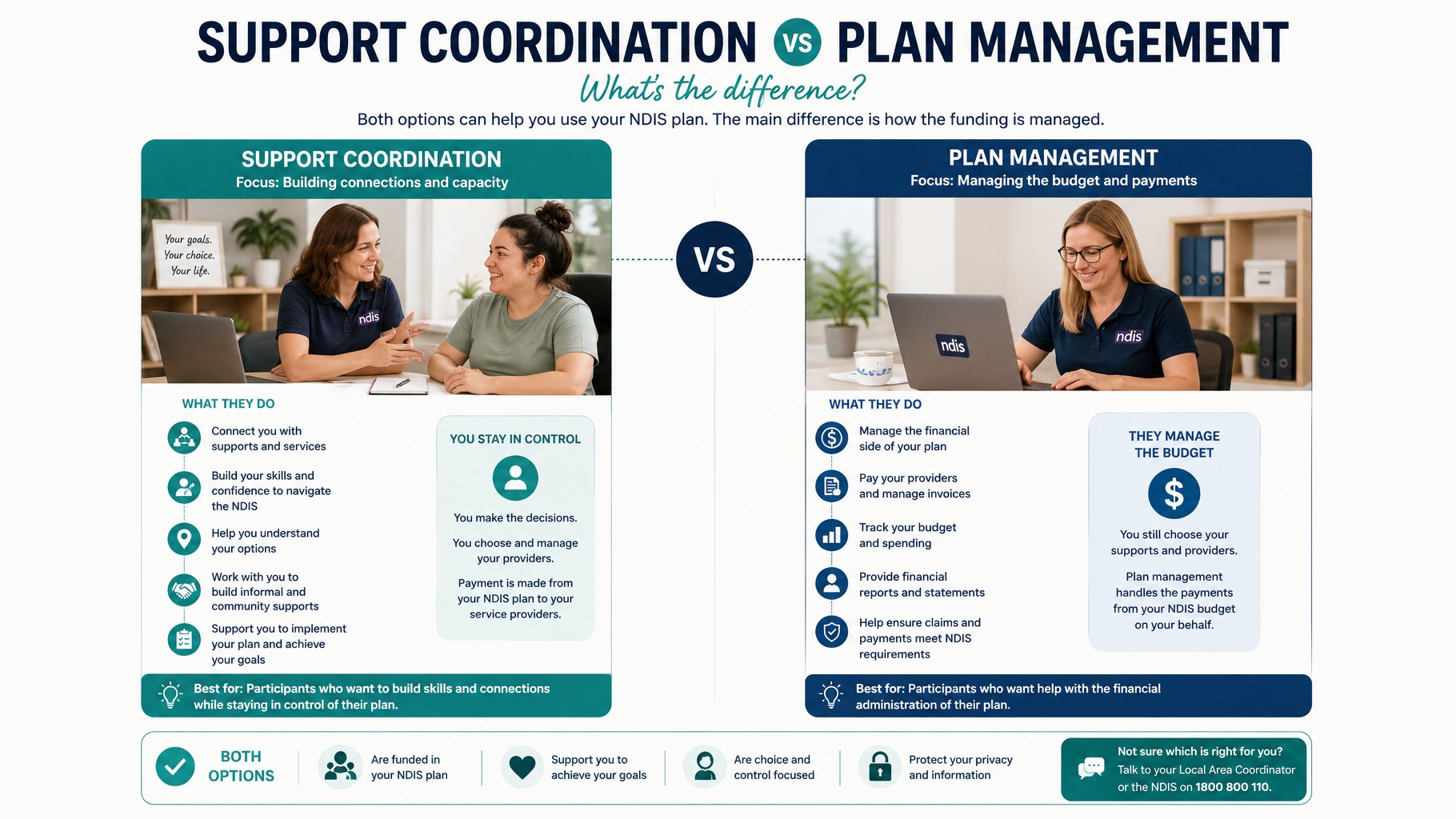
Plan management is about money. A plan manager pays your providers'' invoices, tracks your budgets and handles the bookkeeping — like an accountant for your plan. Support coordination is about people and services. A support coordinator helps you understand your plan, find and connect with providers, and build your capacity to manage supports yourself — like a guide.Many participants have both, funded separately in their plans. Neither replaces the other.
What a Plan Manager Actually Does
Plan management is funded in addition to your other supports if you request it at your planning meeting — it does not come out of your core funding. A plan manager receives invoices from your providers, claims from the NDIA, pays providers, and gives you budget reports so you always know what is left. The practical superpower: with a plan manager, you can use unregistered providers while keeping the paperwork handled — a flexibility agency-managed participants do not have, without the workload of self-management.
Questions to ask a plan manager: how fast do you pay invoices, how do I see my budget in real time, and what happens if a provider over-claims?
What a Support Coordinator Actually Does
Support coordination is funded in your plan only when the NDIA assesses you need it (commonly for participants with more complex situations). A support coordinator helps you make sense of what your funding can be used for, researches and connects you with suitable providers, coordinates between them, prepares you for plan reviews, and steps in when arrangements break down. Higher-intensity "specialist support coordination" exists for the most complex situations.
The single most important thing to know: your support coordinator should be independent of your other providers. A coordinator employed by the same organisation that delivers your daily supports has an obvious conflict when deciding whether that organisation is serving you well. Conflict-of-interest rules exist, but asking directly — "do you recommend providers from your own organisation?" — is the practical test.
Can the Same Organisation Do Both?
It happens, but think carefully. A plan manager who also coordinates your supports, or a coordinator whose employer delivers your services, concentrates a lot of influence over your plan in one place. Many participants deliberately split these roles across different organisations precisely to keep everyone honest.
The Bottom Line
If paperwork and paying invoices are the burden — you want plan management. If finding, connecting and managing providers is the burden — you want support coordination, and it must be in your plan. Most confusion disappears once you remember: one manages the money, the other helps you use the plan. When choosing either, independence and responsiveness matter more than brand size.
This article is general information only — it is not disability, health or NDIS planning advice. Funding rules change; confirm what your plan includes with the NDIA, your planner or your LAC.