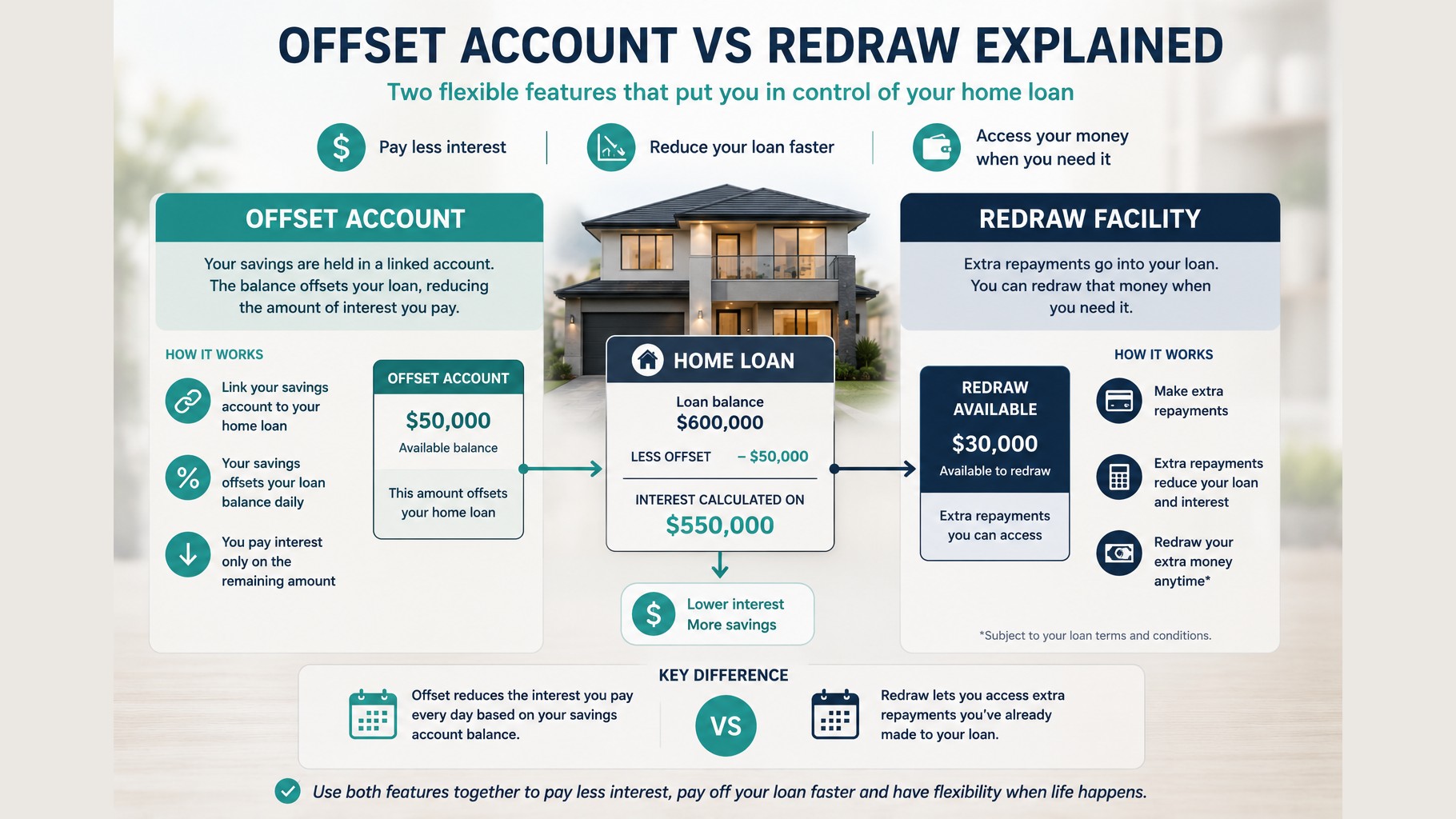
Offset and redraw are two of the most useful — and most confused — home-loan features. Both let your spare money reduce the interest you pay, but they work differently, and the difference matters, especially for investors.
Both save you interest — differently
Interest on your loan is usually calculated on the balance you owe. Both offset and redraw reduce that balance for interest purposes without you formally repaying the loan — but the mechanics differ.
What an offset account is
An offset account is a everyday transaction account linked to your home loan. The balance in it is "offset" against your loan for interest calculations. Put $20,000 in an offset against a $500,000 loan, and you''re charged interest as if you owed $480,000 — while the $20,000 stays fully yours, accessible any time like a normal bank account.
What redraw is
Redraw is different: it''s the ability to pull back extra repayments you''ve already made. If you pay more than your minimum, that surplus reduces your loan balance (and your interest), and redraw lets you access it later if you need it.
The practical differences
Access and flexibility. Offset money sits in a normal account — instant, everyday access. Redraw money has technically been paid into the loan; accessing it can be slightly less immediate and some lenders limit or charge for redraws. Tax (for investors). This is the big one. For an investment property, redrawing funds for personal use can muddy the tax-deductibility of your loan interest, because you''ve effectively re-borrowed. An offset generally keeps things cleaner, since the money was never mixed into the loan. If you''re investing, get accounting advice on this — it''s a common trap. Fees. Offset accounts sometimes come with a slightly higher rate or an annual package fee. Redraw is often free but more restricted. Weigh the cost against the benefit.Which is better for you?
- Want everyday flexibility, or investing? An offset is usually the cleaner, more flexible choice.
- Just want to pay down your own home faster and park surplus? Redraw can do the job without extra cost.
- Many borrowers use both.
The bottom line
Offset and redraw both put your spare cash to work against your loan, but an offset keeps the money in your own account (more flexible, cleaner for investors), while redraw pulls back extra repayments (often free, a little more restricted). Match the feature to how you''ll actually use your money — and if it''s an investment loan, take tax advice before you rely on redraw.
This is general information, not credit or financial advice — confirm features and costs with your broker or lender, and tax treatment with an accountant.