One decision that shapes your whole plan
When your NDIS plan is approved, you choose how the money in it is managed. It sounds like an administrative detail. It is not. Your management type decides which providers you can use, how much paperwork lands on you, and how quickly you can act when your needs change. Get it right and the plan runs quietly in the background; get it wrong and you spend your energy fighting the system instead of using it.
There are three options, and you can mix them across different parts of your plan.
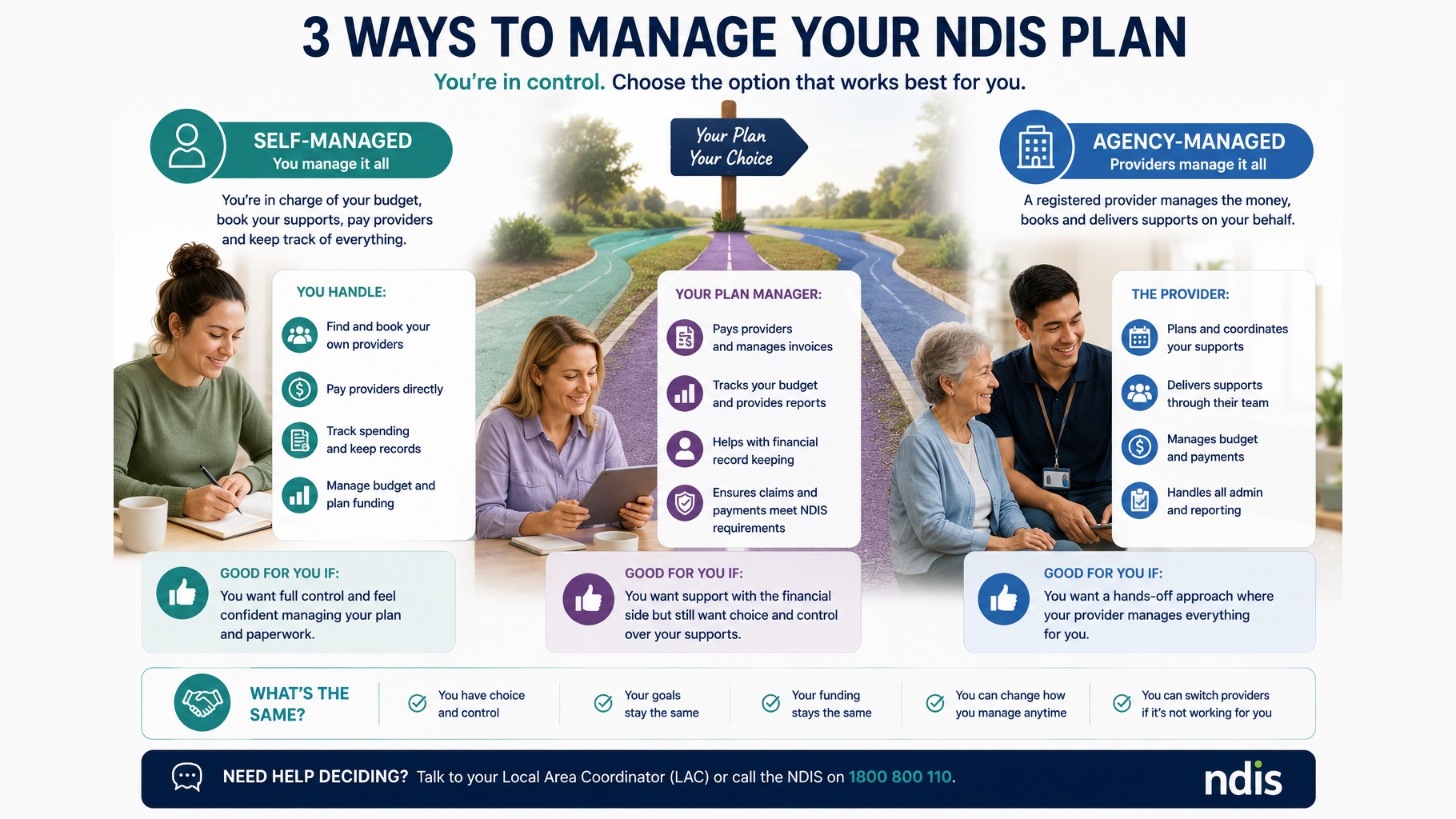
The three options at a glance
Self-managed — You (or a nominee) receive and pay invoices yourself, keep the records, and claim reimbursement from the NDIS. This gives you the most control and the widest choice: you can use registered and unregistered providers, and you can negotiate prices. The trade-off is workload — depending on the size of your plan, the admin can run to several hours a week, and you are responsible for keeping everything audit-ready. Plan-managed — A registered plan-management provider sits in the middle. They pay your providers, track your budget and handle the paperwork, while you still choose your own providers, including unregistered ones. Crucially, plan management is funded separately in your plan (under Capacity Building — Improved Life Choices), so paying for it does not eat into your support budgets. This is why it has become the most popular option: most of the flexibility of self-management, with little of the admin. Agency-managed (NDIA-managed) — The NDIA pays your providers directly through its portal. It is the most hands-off option — no invoices, no claiming — but it comes with the tightest constraint: you can only use NDIS-registered providers. In metro areas that is usually fine; in regional areas it can noticeably shrink your choices.How to choose
Ask yourself three questions.
1. How much control over providers do you want? If there is a specific unregistered provider you want — a particular therapist, a support worker, a local business — agency-managed rules them out. Plan-managed and self-managed both allow them. If you are happy to stay inside the registered list, agency-managed is the simplest. 2. How much admin can you realistically carry? Self-management rewards people who are organised and want to negotiate and optimise every dollar — but it is a real, ongoing job. If that sounds draining, plan management gives you almost the same freedom without the bookkeeping. Agency management removes the admin entirely. 3. How much flexibility will your plan need? Plans that change often, or that mix mainstream and niche supports, are easier to run when you are not waiting on the agency to process each payment. Self- and plan-management both move faster than agency management here.You don't have to pick just one
A common misunderstanding is that the whole plan must be managed the same way. It doesn't. You can, for example, self-manage your core supports (where you want maximum flexibility) while leaving capital supports agency-managed (where you don't). If one part of your plan is straightforward and another is fiddly, split them.
A quick rule of thumb
- Want maximum choice and control, and don't mind the paperwork → self-managed.
- Want choice of provider without the admin → plan-managed (funded separately, so effectively free to you).
- Want zero admin and are happy with registered providers only → agency-managed.
Where a good provider comes in
Whichever route you choose, the quality of the people you actually work with matters more than the management label. A plan manager should be responsive and transparent about your budget; a support provider should put its services and terms in writing. Those are exactly the things worth comparing — and reading a provider's reviews and checking its registration status (for the supports where that matters) will tell you more than any brochure.
CompareMyAgents lists NDIS providers with verified registration status and real reviews so you can compare on what matters. We are independent and take no payment from the providers listed. This article is general information, not advice about your individual plan.